Adventurer Guild ranking system
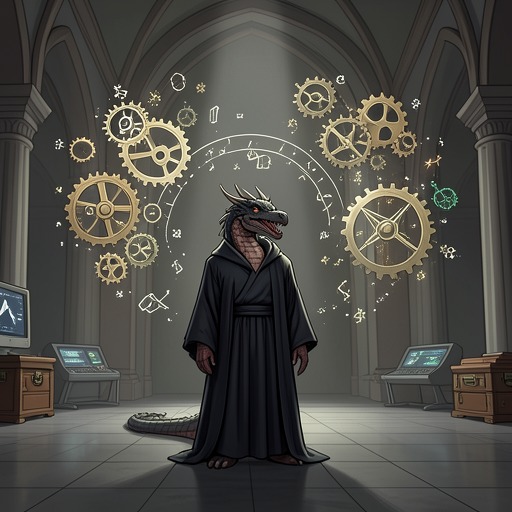
Vainqueur the DragonThe Adventurer Guild ranking system is the institutional framework through which clients post dangerous work, adventurers accept it for promised rewards, and the guild records professional advancement. It joins paperwork, public classification, quest incentives, and monster-hunting into one mechanism. In practice, the system is designed for human adventurers, yet Vainqueur Knightsbane forces it to accommodate a dragon who regards every conventional measure—from rank plates to bodily abilities—as an insultingly inadequate description of his superiority.
Definition and Administration
The system is administered locally through the Gardemagne Adventurer Guild. Charlene, the guildhall’s chief of staff and receptionist, explains that she manages paperwork and requests: clients submit jobs with rewards, and the guild receives and distributes those requests to adventurers and mercenaries willing to undertake them. The arrangement therefore depends on clerical mediation rather than informal heroism alone. A written request becomes a recognized opportunity only after someone in the guild receives it, reads it, and makes its terms available to potential contractors.
The system’s practical purpose is especially visible after the Century War. Many current requests concern roving monsters or brigands, reflecting a landscape in which ordinary authorities and landowners cannot reliably secure their territories themselves. Charlene recalls that lucrative requests and bounties once targeted Vainqueur Knightsbane, until the dragon was declared dead. His return therefore transforms an old category of guild target into a living, enrolled participant in the same institution that once advertised rewards for bringing him down.
Rank Ladder and Visible Status
Every adventurer begins at lead rank. The complete sequence is lead, copper, iron, bronze, silver, gold, and starmetal. Rank is made materially visible through a plate worn around the neck: Vainqueur Knightsbane and Victor Dalton are issued a lead plate bearing Victor Dalton’s name, and Vainqueur Knightsbane treats the object as an affront to his identity rather than as a neutral administrative credential. He objects that a dragon who can fly, breathe fire capable of melting stone, and potentially live forever should not be placed below gold merely because the guild’s scale was built for mortals.
The plate nevertheless carries institutional value. When Vainqueur Knightsbane returns to Louise de Carabas’s estate after completing work, he points to the lead tag as proof that he is an adventurer and claims that his service entitles him to six thousand gold coins. Louise de Carabas initially reads the plate as evidence that the dragon has entered the guild’s procedure, even though the arrangement remains so abnormal that she seeks an explanation from Count Gilbert. The insignia thus functions simultaneously as status, evidence of authorization, and a prop in Vainqueur Knightsbane’s attempt to convert bureaucratic recognition into bargaining power.
Quests, Rewards, and Incentives
The guild’s requests are concrete contracts built around a stated objective and promised compensation. One request offers one thousand gold pieces for the return of Louise de Carabas’s family Silver Rapier, last reported in the hands of goblins in the Albain Mountains. The request includes a drawing of the sword, giving the contractor both a description and a recoverable object to identify. Victor Dalton sees the commission as relatively easy money because most goblins have already fled the mountains, while also viewing access to the Carabas estate as a chance to scout for valuables.
Another request concerns a clan of trolls known as the Branded Barks, who have sacked the lands of the Count of Provencal and hidden in the Woods of Gevaudan. The Count offers a substantial reward for exterminating them. Vainqueur Knightsbane immediately asks whether deeds of this kind grant experience and levels, revealing that the guild quest has become more than a source of payment: it is a possible advancement engine. The system links public service, violence, compensation, and personal power, encouraging adventurers to interpret dangerous work as measurable progress.
That logic also produces exploitation and misalignment. Vainqueur Knightsbane expects full payment for the destruction attributed to his work, while the local authorities and guild must interpret the dragon’s actions through existing contracts and procedural categories. Victor Dalton, acting as chief of staff, translates between Vainqueur Knightsbane’s demands and the human institutions that must answer them. The guild’s mechanism can mobilize force efficiently, but it cannot guarantee that the strongest contractor will accept the reward, the rank, or the limits originally intended for ordinary adventurers.
Advancement, Exceptions, and Institutional Strain
The system recognizes advancement through more than plates. Vainqueur Knightsbane gains a level in the Noble class through his ego and dragon bloodline, while Victor Dalton gains a level in the Monster Squire class after becoming the chief enforcer of a mighty dragon. Later, Victor Dalton earns seven Monster Squire levels for fearlessly leading monsters against superior opponents. These outcomes show that the wider progression system converts conduct and role into formal power, even when the conduct takes place at the edge of guild administration rather than inside a conventional adventuring party.
The guild responds to the dragon cautiously. After Ogron the Ogre’s last meal, the guild upgrades both Vainqueur Knightsbane and Victor Dalton to copper-rank adventurers. The officials still do not know how to handle the dragon and appear to follow due process until King Gardemagne or the Shining Crusade settles the matter. The promotion is therefore less a confident judgment than an attempt to preserve administrative continuity. Instead of inventing a new category for Vainqueur Knightsbane, the guild applies its next ordinary step and postpones the deeper constitutional problem.
The same tension reappears when Vainqueur Knightsbane recruits monsters for war against Furibon. The applicants include one hundred kobolds, along with a troll, a dryad, and a golem whose class levels exceed twenty. The guild-like logic of applications, class levels, and organized missions has expanded beyond human adventuring into monster mobilization. Vainqueur Knightsbane’s forces later develop commercial and civic institutions of their own, including Nethermart, a magic-item shop open to monsters and mortals. The ranking-and-quest model thus becomes part of a broader process in which monsters appropriate, redirect, and eventually build upon systems originally designed for human adventurers.
Consequences and Narrative Significance
The Adventurer Guild ranking system supplies the book’s clearest bridge between fantasy adventure and institutional bureaucracy. A dragon’s power is not enough for Vainqueur Knightsbane; recognition requires a plate, a recorded status, and a quest that can be presented as legitimate service. His outrage makes visible the difference between actual capability and administrative classification. The guild can acknowledge what he does only by placing him inside a ladder whose categories were never designed for him.
At the same time, the system gives Vainqueur Knightsbane and Victor Dalton a language for expansion. Quests provide targets, rewards provide resources, ranks provide public legitimacy, and levels provide a game-like account of growth. The pair repeatedly transform commissions into leverage: Victor Dalton handles documents and negotiation, while Vainqueur Knightsbane turns completed work into demands for treasure, reputation, and further advancement. Even the dragon’s later destruction of the surrounding area after a Bragging Day leaves his servants, including the Kobold Rangers, organized under command, demonstrating how the administrative impulse survives its original guild setting.
The system’s deepest irony is that procedure both restrains and empowers the dragon. It initially humiliates him with a lead plate, but the same framework lets him claim the title of adventurer, demand payment, recruit followers, and convert violent deeds into recognized progression. By extending ordinary rules to an extraordinary subject, the guild unintentionally legitimizes Vainqueur Knightsbane’s intrusion into human society. What begins as a ranking system for freelance problem-solvers becomes, through misuse and adaptation, one of the institutional foundations for a new monster-centered order.